Preface
The question behind “What Are Bagasse Containers Made From” looks like a choice of appearance or material, but packaging performance also depends on the food, geometry, time-temperature history and handling. This article explains the visible problem first, then the material and structural mechanism, and finally the limits of what can be inferred without a product-specific test.
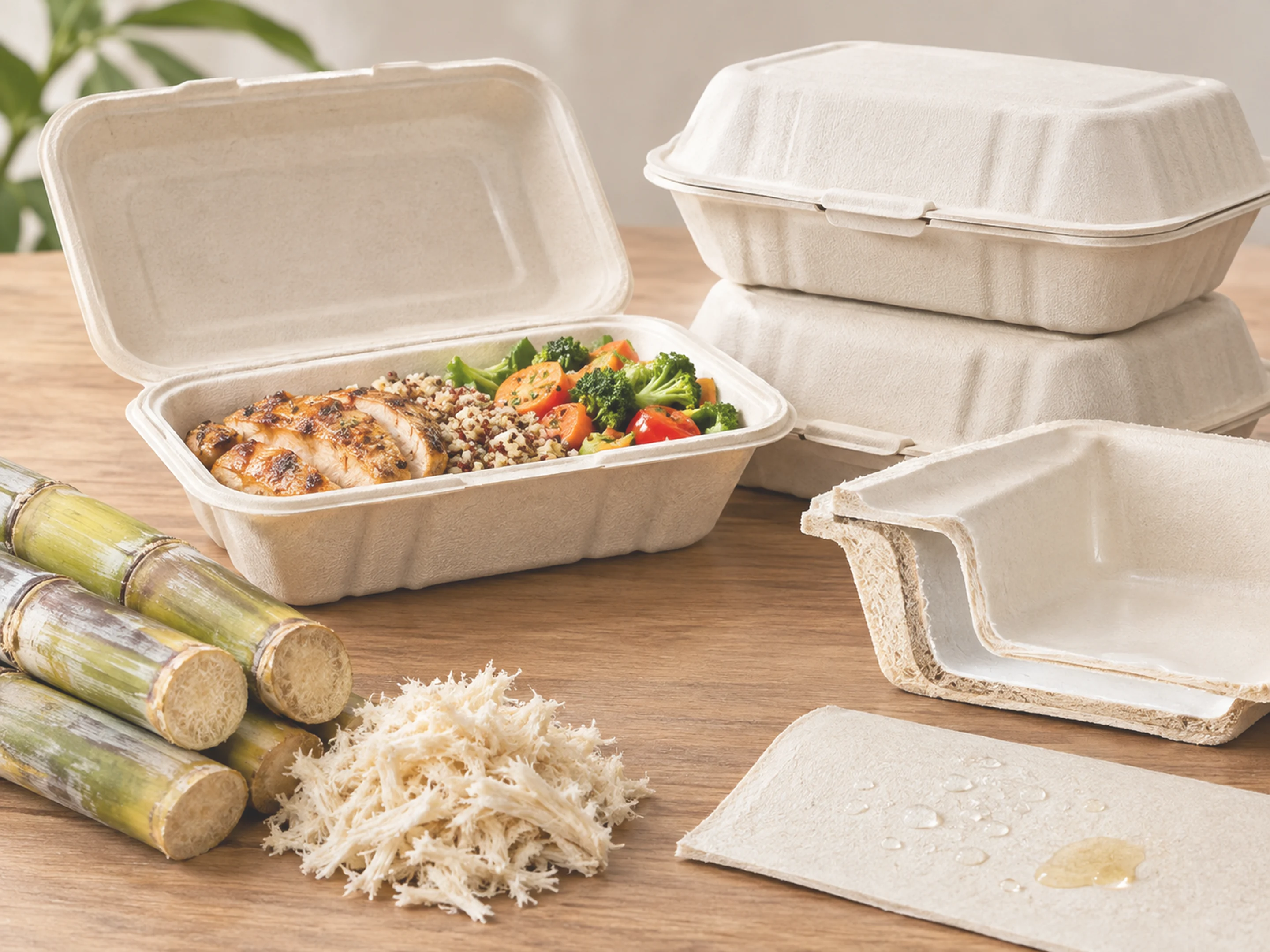
Bagasse containers are commonly made from sugarcane residue fibers. The fibers are dispersed in water as a pulp, dewatered in a mold, pressed, formed and dried. Hydrogen bonding and mechanical entanglement create a network with useful dry stiffness. Once water enters, fibers swell and the network weakens, so molded fiber is not naturally waterproof simply because it is “paper-based.”
Wet strength depends on the fiber selection, forming density, additives and post-treatment. Grease resistance may come from surface treatment, a coating or a denser fiber structure. Soup, curry and oily sauces expose a pack to water and fat at the same time, and a short serving period is different from a long delivery period. Lid retention, bottom support and stack height also affect deformation with hot food.
A common error is assuming that “sugarcane” or “natural” proves compostability, or that every molded-fiber tray can hold boiling soup. End of life depends on coatings, plastic lids, local facility acceptance and food residue. EPA’s definitions make clear that compostability refers to a defined process and facility, not instant disappearance in nature.
For a practical check, inspect dry stiffness and closure first, then use the intended food at the intended temperature. Record softening, leaks, odor and bottom sag together with contact time, tilt and stacking. The result may support short hot-food service, chilled food or dry goods, but the conclusion should stay within the tested conditions. References: