Preface
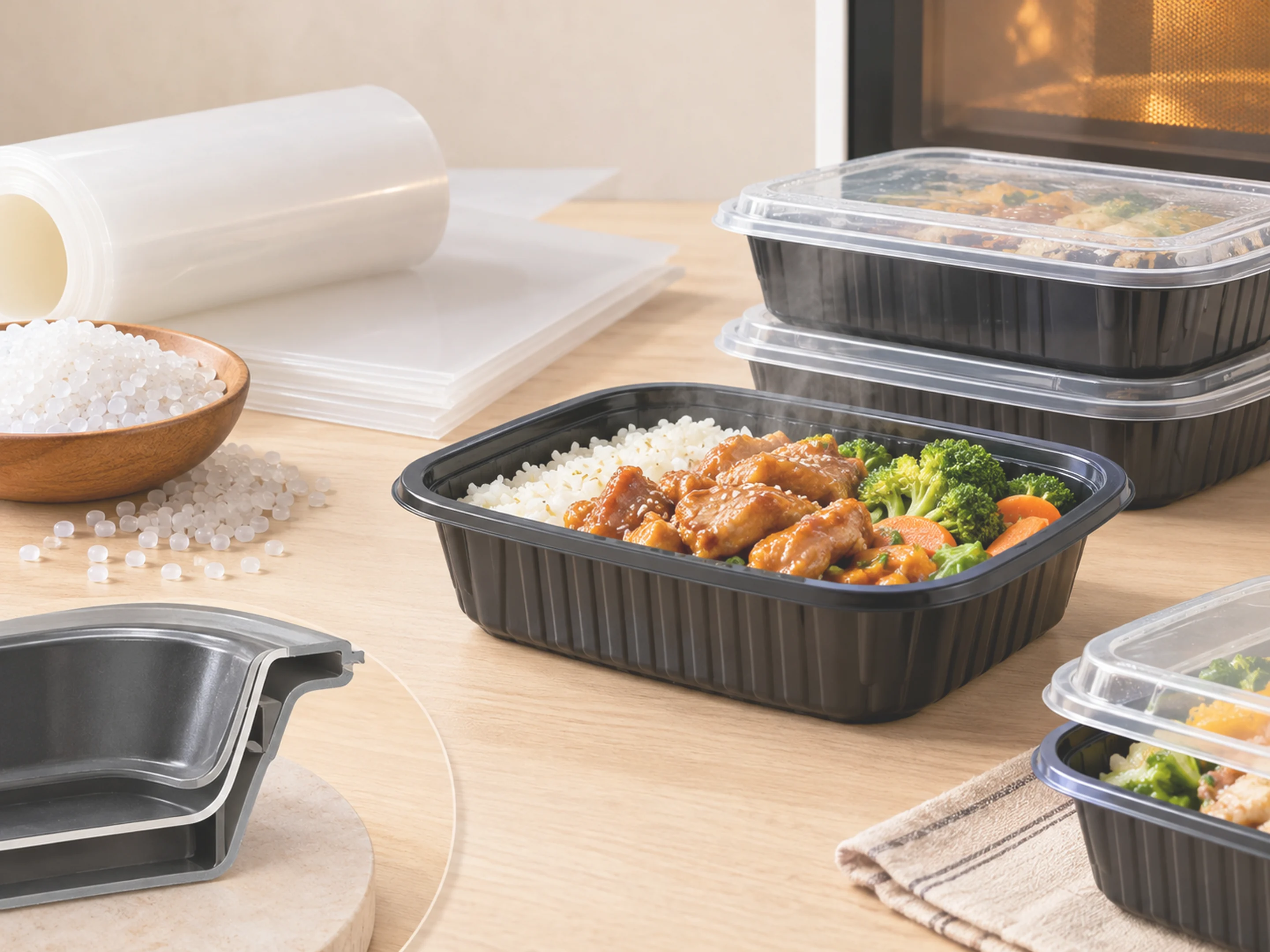
PP is common in hot-food containers because material, forming and lid design create a useful combination of properties, not because one code or slogan grants unlimited heat resistance. This article separates hot filling, microwave reheating, grease and steam.
PP’s useful heat performance comes from its semicrystalline structure and the temperature range in which its chains can move. During forming, some chains arrange into ordered regions that act like a distributed framework. That helps a container hold its shape during filling, stacking and short reheating. A container is not a uniform slab, however: the base, sidewall, corners, flange and snap features have different thickness and loads, so local distortion can occur first.
For hot food, begin with the fill temperature and the time the food remains in the pack. Oil, soup and syrup change the contact environment. The same 90°C food can create different pressure and lid movement in an open bowl and a tightly closed deep container. If the lid has no suitable vent, reheating steam can load the seal and snaps, causing a lifted rim, blown lid or leak.
“Microwave-safe” is not a single material property. A microwave heats food through dielectric interactions, and water content, salt, viscosity and fill amount affect the temperature map. Syrups, oil-rich areas and dry edges can become hot spots. An empty container is not a normal use condition. Follow the finished-product instructions for venting, power, time and fill.
A common mistake is treating the number 5 on a base as a microwave approval. A resin code identifies a main resin family; it does not describe the lid, colorants, gasket, print or the validation of the complete product. Another mistake is extending short microwave reheating to an oven claim. Microwave, steam, oven and hot-fill conditions are different boundaries.
For a practical check, use the target food at low, medium and high fills and record closure, bulging, warpage, leakage and handling temperature. If the pack is for a store, keep appliance power, reheat time, starting temperature and vent position constant before comparing batches. Performance must be tied to a particular food and appliance condition.
References: [1] FDA — Food Types & Conditions of Use — https://www.fda.gov/food/packaging-food-contact-substances-fcs/food-types-conditions-use-food-contact-substances; [2] European Commission — Food Contact Materials — https://food.ec.europa.eu/food-safety/chemical-safety/food-contact-materials_en; [3] Agarwal et al. — Food Packaging Materials — https://pmc.ncbi.nlm.nih.gov/articles/PMC9389508/