Preface
A container that does not leak on a table may still leak in a delivery bag. This guide explains leakage through the seal interface and transport loads.
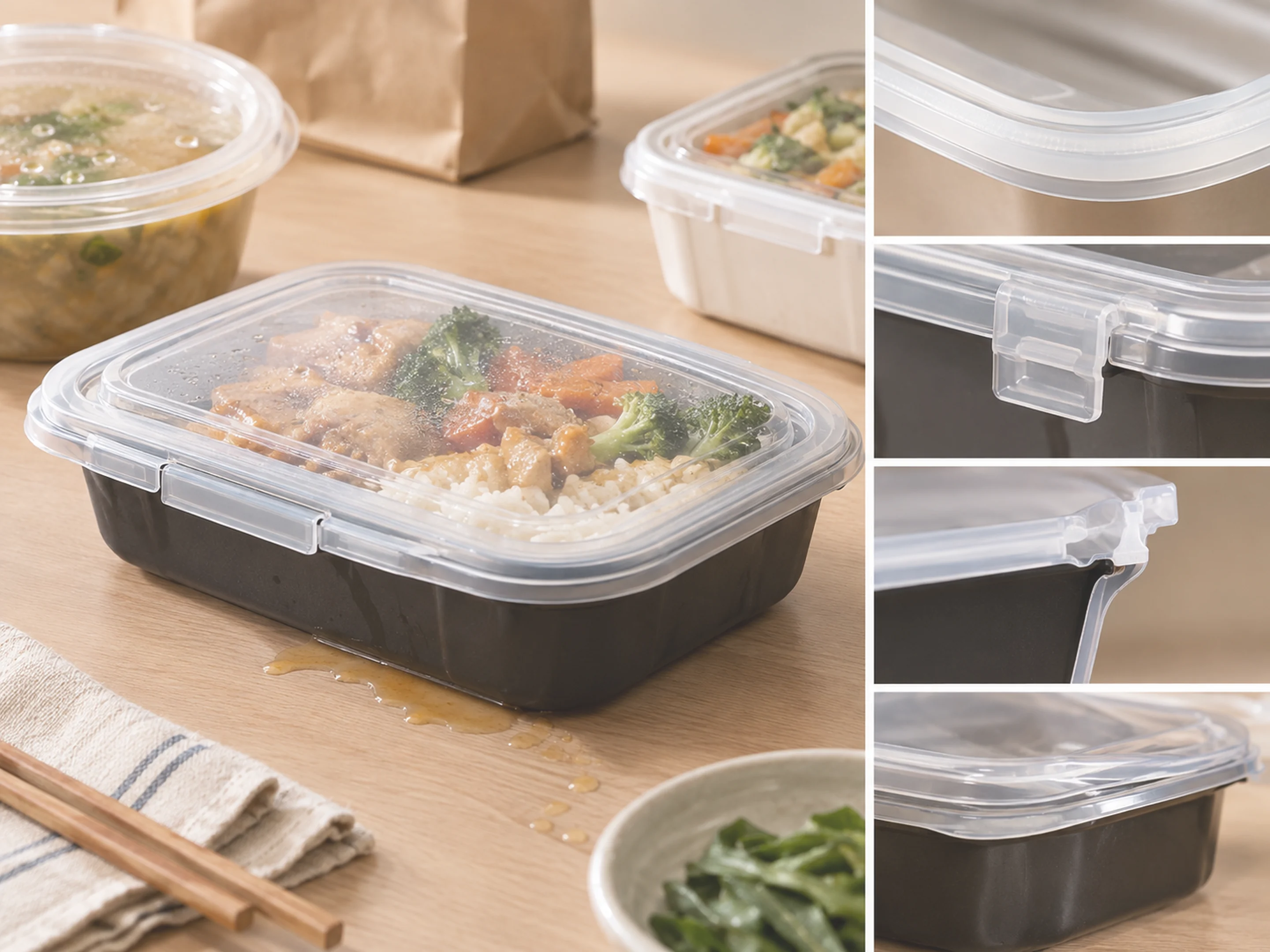
A seal usually forms along a continuous contact line between the rim and lid. Snaps provide retention force, the rim provides contact pressure, and material recovery helps compensate for small dimensional variation. If the rim is warped, burred or greasy, a tight snap can still leave a local gap through which liquid escapes.
Hot soup magnifies the problem. Temperature makes the base and lid expand differently, while steam raises pressure inside. A tilted delivery keeps liquid against one side of the seal, and vibration repeatedly opens a small gap. After cooling, lower pressure can pull the lid inward, so the behavior changes again.
Continuous ring seals, overflow channels and multiple snaps have different jobs. An overflow channel can hold a small amount of liquid but does not replace the primary seal. More snaps are not automatically better; if their positions do not match flange stiffness, they can concentrate force at a few points.
Leak validation should use the real food, or a close substitute for viscosity, temperature and grease, followed by static, tilt, vibration, stacking and thermal-cycle checks. The leak location matters: a snap, corner, hinge or lid surface points to a different cause. A single upside-down test describes one moment, not the delivery system.
References: [1] FDA — Food Types & Conditions of Use — https://www.fda.gov/food/packaging-food-contact-substances-fcs/food-types-conditions-use-food-contact-substances; [2] European Commission — Food Contact Materials — https://food.ec.europa.eu/food-safety/chemical-safety/food-contact-materials_en