Preface
The question behind “Why Hot Soup, Hotpot and Saucy Takeaway Foods Challenge Containers” looks like a choice of appearance or material, but packaging performance also depends on the food, geometry, time-temperature history and handling. This article explains the visible problem first, then the material and structural mechanism, and finally the limits of what can be inferred without a product-specific test.
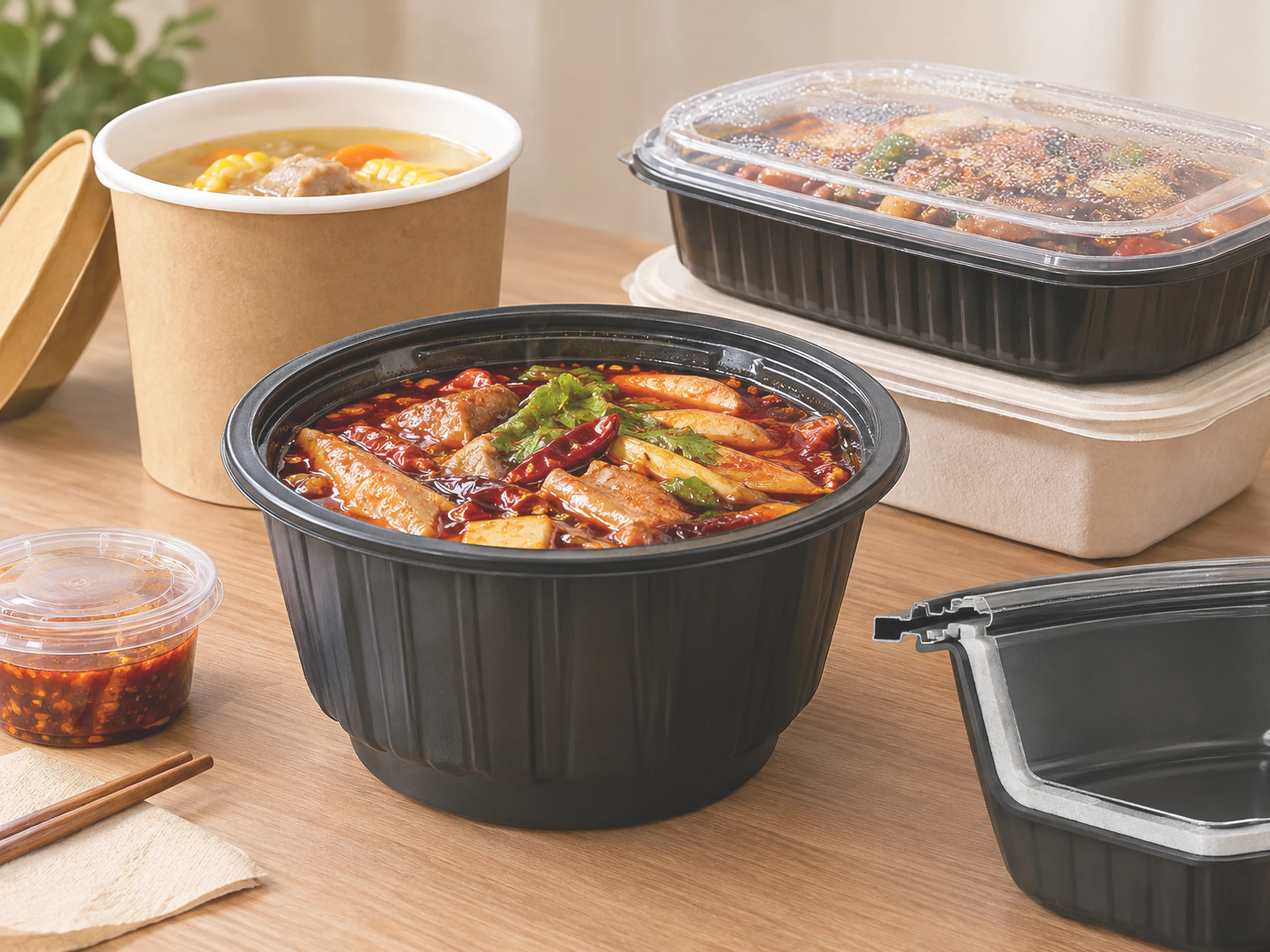
A soup container carries a liquid load rather than a solid portion supported only at the base. Soup weight acts on the bottom and side walls. Grease changes wetting at the sealing interface, while heat creates different expansion in the body and lid. Tilt, sudden stops and vibration during delivery combine these effects, so leaks may appear at the rim, a divider or a thin bottom section.
Most closure systems need designed compression so the seal remains in contact across normal dimensional variation. Too little compression allows a small warp to create a channel; too much can distort the lid or make opening difficult. Hot soup also produces vapor. A sealed pack may experience pressure changes as it heats or cools. Venting is not automatically better because an opening can also become a liquid path.
“Heat resistance” addresses only part of the problem. Test with the real soup, target fill, closure action and delivery posture. Check standing, tilt, inversion, stacking and simulated transport. Oily curry and clear broth have different flow and wetting behavior, so one recipe cannot represent every menu item.
Record temperature history, fill, closure action, delivery time and the pack’s position in the bag. If reheating is intended, microwave or steam-release instructions need to be specified separately. References: